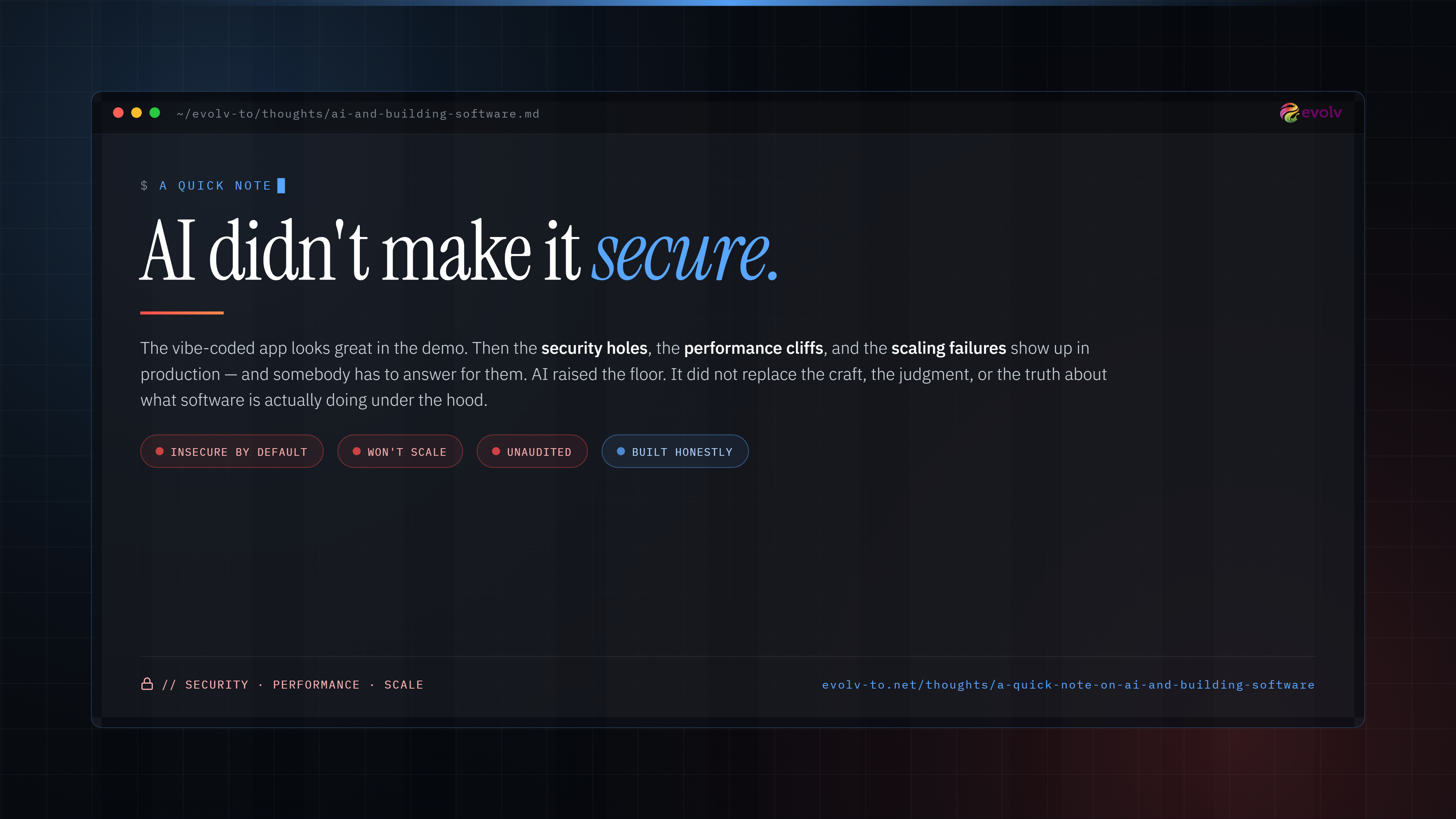
A Quick Note On AI And Building Software

I use AI every day. It’s the most powerful accelerator I’ve ever had as a builder, and a lot of what I’m shipping right now wouldn’t be possible without it. That doesn’t mean I love it. Some days it saves me hours. Other days it costs me the whole day and then some. Both are true, and anyone telling you only the first half is selling you something.
I want to share something that’s getting lost in the hype.
AI Is Useful, As Long As You Have The Knowledge To Keep It On Track
It’s an incredible pattern-matcher. Ask it to build a login page and 30 seconds later you’ll have something that looks like a login page. What you won’t see is whether it has password hashing, rate limiting, a bot check like Turnstile, secure cookies, or a password reset flow that doesn’t leak which emails exist in your database. Those aren’t optional. They’re the difference between a form on a screen and something you can actually put in front of real people.
And that’s just the technical side. A modern site also needs a cookie banner, a privacy policy, an unsubscribe link in every email, and a basic plan for handling customer data responsibly. None of that comes out of “build me a website.” All of it matters the moment a real person signs up.
This Isn’t Just A Code Problem
This isn’t a problem with one tool or one company. It’s the same story across every generator out there. Image AI gives you a beautiful portrait with six fingers and a logo that almost matches a real brand. Video AI gives you a clip where the character’s jacket changes pattern between cuts. Code AI gives you a login page with no rate limiter. The model produces something that looks like the answer because it has seen a million things that look like the answer. It does not understand fingers, physics, contracts, or production. A non-expert sees a finished result. An expert sees what’s missing.
The Time You “Saved” Might Not Be Real
Here’s the part nobody talks about: the time AI saves you is mostly perceived, and the quality is mostly perceived too.
A generated image looks finished on your screen. But if you want to print it on a flyer, now you need it in CMYK, at 300 DPI, with bleed, in a vector or print-ready PDF, with the right color profile so the press doesn’t shift your brand colors. If you want it on your website, now you need it resized for mobile and desktop, compressed without losing quality, in WebP with a JPEG fallback, lazy-loaded, properly cached, with alt text, and small enough that it doesn’t tank your page speed. None of that comes out of the prompt. The ten seconds you saved on the generation just turned into two hours of cleanup, and that’s assuming you know what cleanup is needed. If you don’t, you ship something that looks fine to you and looks broken to everyone else.
The same thing happens with code. The AI writes it in 30 seconds and the demo video ends there. What it doesn’t show is the next four hours of figuring out why it doesn’t work in your specific setup, the security holes you didn’t know to look for, the legal pieces that aren’t in the prompt, and the production behavior that only shows up after a real user touches it. The generation was fast. The actual finished product takes the same amount of time it always did, the work just got moved to a different place.
Where Real Engineering Comes From
This is where real engineering comes from. Not the prompt. Not the first output. The judgment to know what’s missing, the discipline to fix it, and the experience to recognize the difference between something that looks finished and something that actually is.
Saying “build me this, make it this color, deploy it, point a domain name at it” does not make it quality. It does not make it software. It does not make it secure. It does not make it work. It’s smoke and mirrors. It may look pretty on day one, but what is under the hood? What is it going to look like when you need to add a feature? What happens when you tell the AI “add this menu item” and it builds you a whole new menu in a whole new structure, in a whole new place, using a whole new pattern, because it doesn’t remember or understand the one that already exists?
You end up with a site where every page is written differently, every component is built differently, every style is applied differently. That is the exact problem we had thirty years ago. AI hasn’t moved engineering forward there. It has made the problem worse, faster, at scale. All of the same requirements for an engineer to do it right are still there. AI is a tool. It helps write code, it helps organize tasks and thoughts, it is a real accelerator in the right hands. But it is not a replacement for the engineer. It never has been, and right now it isn’t close.
You Still Need A Real Process
And it’s also why you still need a real software development lifecycle around all of this. Requirements, design, version control, code review, automated tests, security scanning, staging environments, deploy gates, monitoring, rollback plans. None of that goes away because AI is writing the code. If anything it matters more, because the thing writing the code has the exact same blind spots as the thing you’d ask to review it.
AI ignores rules it was told to follow. It skips steps. It does things one way today and a different way tomorrow. It “checks” something by generating text that looks like a check, without actually verifying. You cannot trust an AI to quality-check its own work, any more than you’d trust an author to be the only proofreader of their own book. The lifecycle exists because humans make mistakes consistently, and AI makes a different set of mistakes just as consistently. You need the process either way.
How This Goes Wrong, From Someone Living It
You ask the AI to fix one thing. It fixes that one thing and quietly changes three others you didn’t ask about. It tells you the deploy succeeded without checking. It writes code that works in the happy path and forgets the part where the user closes the browser tab in the middle of a process that’s costing you money by the minute. It states things confidently that turn out to be wrong, and you only find out after you’ve acted on them.
None of that shows up in the demo videos. All of it shows up in your bill, your logs, and your weekend.
This stuff isn’t hard once you know it exists. The problem is AI won’t tell you it exists. It’ll happily build the parts you asked for and stay quiet about the parts you didn’t.
What Should Worry Everyone
Here is the part that should worry everyone, because it’s already happening at scale.
Inside large corporations right now, a massive amount of AI-generated code is being shipped without anyone really reading it. Not because the engineers are lazy, but because they’re overwhelmed. The volume of code coming out of these tools is more than any human team can review honestly. So corners get cut. Approve buttons get clicked without the diff being read. Deploys get rubber-stamped. Some of them are now triggered by AI itself, with a human pretending to supervise.
When you see a major outage in the news, or a data exposure, or a service that mysteriously fell over for half a day, the press release will say “technical issue” or “service disruption.” It will rarely say what actually happened. But more and more often, what actually happened is on this list. Generated code that nobody verified, shipped past a process that nobody enforced, into a production system that nobody fully understood anymore.
The Real Risk
The risk I’m watching right now isn’t AI itself. It’s the wave of people, and the wave of companies, being told they can skip the fundamentals and prompt their way to a finished product. That works for a weekend project. It does not work for anything holding real customer info, real money, or a real brand.
If you’re new to building with AI, don’t let anyone sell you the shortcut. Learn enough of the craft to tell when the AI is wrong, because it will be wrong, confidently, and the cost of missing it lands on you, not on the model.
If you’re experienced, you already know. Keep mentoring the people coming up behind you. They need it.
AI is the most powerful tool I’ve ever had. It’s also the most dangerous one to hand to someone without the judgment to steer it. Both can be true at once.
0 Comments
Leave a comment